
If a family member is being held in a South African correctional centre and you want them to have a laptop for study, work, or keeping in touch with legal representatives, the short answer is that personal laptops are not permitted. The Department of Correctional Services treats unapproved electronic devices as contraband, and an inmate found in possession of one can face disciplinary action that affects their parole date and privileges.
That does not mean study or rehabilitation stops at the gate. The Correctional Services Act 111 of 1998, read with the Constitution, gives sentenced and awaiting-trial detainees a right to programmes that support rehabilitation and education. What it does not do is give them a right to bring their own hardware. The route to any computer access runs through formal approval by the Head of Centre, not through a courier or a parcel handed in at visiting.
This article sets out, in practical terms, what families and applicants actually need to know: what the rules are, how a study-based request is processed, what happens when a device is brought in without approval, and what to do if a legitimate study need is being blocked.
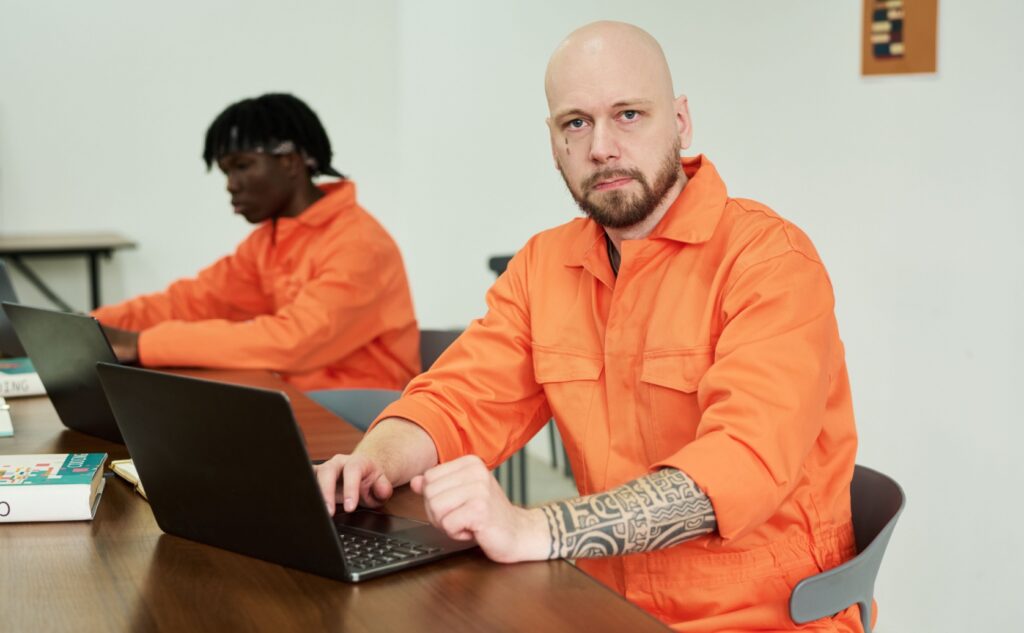
What the Law Says About Personal Devices in Custody
The starting point is the Constitution of the Republic of South Africa, 1996. Section 35(2) gives every detained person, including sentenced offenders, the right to conditions of detention consistent with human dignity, and Section 35(2)(e) specifically includes the right to reading material and, where possible, to communicate with family. None of these rights extends to a personal laptop or unsupervised internet access.
The binding framework is the Correctional Services Act 111 of 1998, together with the regulations made under it. The Act and regulations give the Head of Centre wide authority to control what enters a correctional centre, to search inmates, staff, and visitors, and to declare unauthorised items contraband. Cellphones, smartphones, tablets, and personal laptops fall squarely within that category. Possession is a disciplinary offence and, in many cases, a criminal one.
The White Paper on Corrections in South Africa, published by the Department of Correctional Services, reinforces this approach. It frames custody around security, rehabilitation, and the prevention of crime from inside a centre, which is why any technology that allows unmonitored communication is treated as a security risk.
Can an Inmate Have a Laptop at All?
In limited circumstances, yes, but only on the centre’s terms. A sentenced inmate who is registered for formal study with an accredited institution, or who is taking part in an approved skills or rehabilitation programme, may be allowed to use a centre computer, or in rare cases to keep an approved device in a controlled setting. Any approval is subject to conditions set by the Head of Centre and is not a general right.
What is almost never allowed is an inmate’s personal laptop, brought from home, used unsupervised in a cell. The risk of unmonitored communication, access to illegal content, contact with complainants or witnesses, and coordination of criminal activity outside the centre is the reason the rules are this strict. The Department of Correctional Services does not distinguish between a “study laptop” and any other device unless it has approved the device and the study plan in advance.
How an Approved Study Device Works in Practice
Where computer access is granted, it usually takes one of three forms, all of which are controlled by the centre rather than by the inmate.
- Centre-run computer labs. Many correctional centres have a learning centre or resource room with desktop computers. These are used during scheduled sessions, under supervision, and have no general internet connection.
- Approved study materials on a centre device. An inmate registered with UNISA, a TVET college, or another accredited provider may be allowed to load study material onto a centre-approved device, usually offline and subject to search.
- Restricted devices for specific programmes. In limited cases, an approved tablet or laptop may be issued for a defined rehabilitation, legal, or educational purpose, with connectivity tightly controlled or absent.
In every case the device does not belong to the inmate in the ordinary sense, it is logged, searched, and managed by the centre. Family members should not assume that buying a laptop and arranging to deliver it will be accepted. It will not.
The Approval Route: What Families Should Do
If an inmate has a genuine educational or legal need that requires computer access, the correct route is formal written application through the Head of Centre, supported by proof of registration or instruction. The process is administrative, and pushing it through the wrong channel, such as handing a device to a staff member or bringing it to a visit, will be treated as an attempt to introduce contraband.
- Get written proof of the study need: a UNISA or college registration letter, a course outline, or correspondence from a legal representative.
- Address the application to the Head of Centre at the specific correctional centre, not to a generic departmental email.
- Set out exactly what is being asked for: supervised access to a centre computer, permission to load study material, or consideration of an approved device.
- Keep copies of everything. If the request is refused or ignored, a paper trail is what allows an attorney or the Judicial Inspectorate to take it further.
- Do not send or bring any device into the centre before written approval is in place.
Applications can be slow, and outcomes depend heavily on the centre, the inmate’s classification, behaviour record, and the security level of the unit. Patience and a complete paper file matter far more than persistence at the gate.
What Happens if a Device Is Found in a Cell
An unauthorised laptop, tablet, or phone found in an inmate’s possession is treated as contraband. The consequences are serious and often permanent for the inmate’s progression through the system.
- Disciplinary hearing. The inmate can be charged under the Correctional Services Act and regulations, with sanctions ranging from loss of privileges to solitary confinement.
- Loss of credits and parole implications. A finding of misconduct can delay classification, sentence remission, and placement on parole.
- Criminal charges. Possession of a cellphone or unauthorised device inside a correctional centre can be prosecuted separately under the Act.
- Consequences for the visitor or family member. A person who brings a device into a centre can be removed, barred from visiting, and criminally charged.
The risk is not worth it. If an inmate needs technology for a legitimate purpose, the only safe route is an application through the Head of Centre, with legal support where it is being refused.
Alternatives When a Laptop Is Not an Option
Where computer access is not approved, the centre is still obliged to support study and contact with family within the limits of the Act. Useful alternatives to push for include the following.
- Centre library and study material. Printed material and correspondence study remain the default channel for incarcerated students.
- Scheduled legal visits. A legal representative can attend the centre privately to take instructions and share documents, which often removes the perceived need for a laptop.
- Approved correspondence through the Head of Centre. Legal and study correspondence can be sent and received subject to centre rules.
- Scheduled phone contact. Where phone access is allowed, it is on a centre phone, monitored, and logged.
Frequently Asked Questions
Can you get a laptop in prison in South Africa?
Not as a personal device. Personal laptops are treated as contraband under the Correctional Services Act 111 of 1998. A sentenced inmate may, in limited cases and only with written approval from the Head of Centre, use a centre computer or an approved device for registered study or rehabilitation, with no general internet access.
Can a family member bring a laptop to a correctional centre?
No. Bringing a laptop, tablet, or cellphone into a correctional centre without written approval is introducing contraband. It can lead to removal from the centre, a ban on future visits, and criminal charges against the visitor, and to disciplinary action against the inmate.
How does an inmate apply for computer access for study?
The inmate, with supporting documents such as a UNISA or TVET college registration letter, applies in writing to the Head of Centre at the specific correctional centre. The Head of Centre decides based on security classification, behaviour, and the availability of supervised facilities, and any approval is subject to strict conditions.
Is internet access allowed for inmates in South Africa?
General internet access is not allowed. Where a centre provides computer access for study or rehabilitation, it is offline or tightly restricted and monitored. Unsupervised internet use is treated as a security risk under the Correctional Services Act.
What happens if an inmate is caught with an unauthorised device?
The device is confiscated as contraband. The inmate can face a disciplinary hearing, loss of privileges, loss of sentence remission credits, delayed parole, and separate criminal charges. A visitor who supplied the device can be barred from the centre and prosecuted.
Can an awaiting-trial detainee use a laptop for their case?
Not a personal laptop. An awaiting-trial detainee who needs to review their docket or prepare for trial should do so through their legal representative, who can attend the centre for private consultations under legal privilege, and through any centre facility approved by the Head of Centre.
Get help with a criminal law matter. If a family member is in custody and you are trying to navigate study access, parole, disciplinary action, or sentence-related issues, the Criminal Law team at Otrebski Attorneys can assist. Our Sandton-based, women-led, Level 4 B-BBEE practice holds a 5-star Google rating across 12 reviews, and Director Nastasja Otrebski personally oversees criminal matters. We work with families across South Africa to engage the Department of Correctional Services through the correct legal channels.
Disclaimer. This article is general information about South African correctional law and the policies of the Department of Correctional Services, not legal advice for a specific inmate or matter. Approval of any device or study access is at the discretion of the Head of Centre and depends on classification, behaviour, and current departmental policy. For guidance on a particular case, consult a qualified attorney or contact the Judicial Inspectorate for Correctional Services.
Get Legal Help Today
Speak to an Otrebski Attorneys lawyer about your matter, or request an appointment and we will call you back.
☎ Call 060 500 3098WhatsApp Us